
 Cockpit, Aston Martin Lagonda (Series 2)
Photos
- Cockpit, Aston Martin Lagonda (Series 2)
 Cockpit, Aston Martin Lagonda (Series 2)
 Cockpit, Aston Martin Lagonda (Series 2)
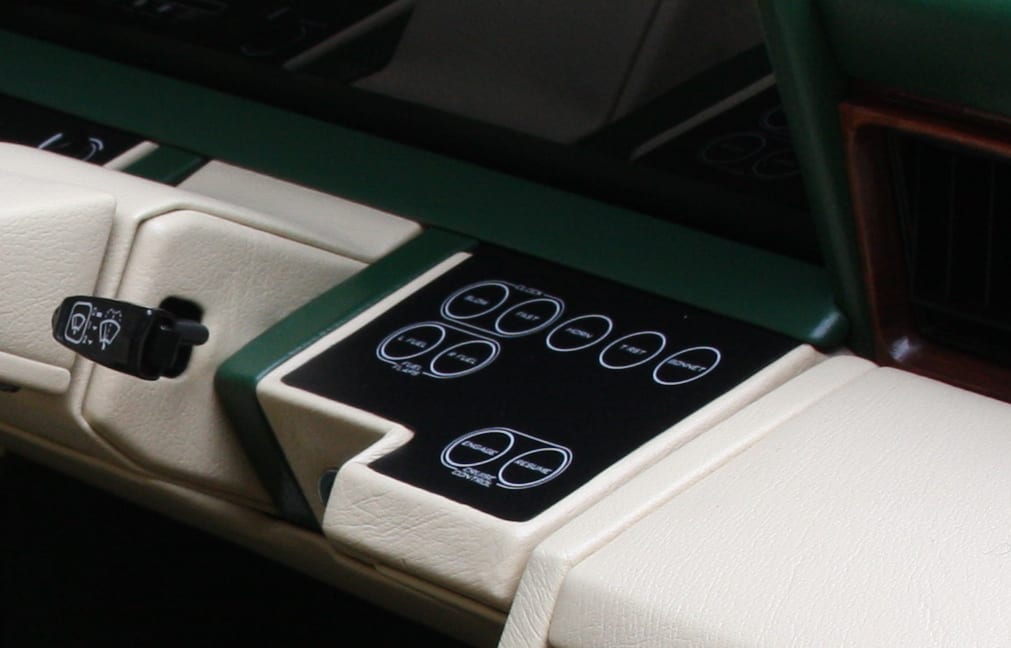 Controls, Aston Martin Lagonda (Series 2)
Photo credits
Photo credits (4)
- Aston Martin Lagonda (Series 2), photo 1Cockpit · “AstonMartinLagonda-interior” (opens in a new tab) · Photo: dave_7 · CC BY 2.0 (opens in a new tab) · Wikimedia Commons
- Aston Martin Lagonda (Series 2), photo 2Cockpit · “1982 Aston Martin Lagonda Interior” (opens in a new tab) · Photo: WikiGhostV12 · CC BY-SA 3.0 (opens in a new tab) · Wikimedia Commons
- Aston Martin Lagonda (Series 2), photo 3Cockpit · “1983 Aston Martin Lagonda Series 2 Classic-Gala 2025 DSC 1046” (opens in a new tab) · Photo: Alexander Migl · CC BY-SA 4.0 (opens in a new tab) · Wikimedia Commons
- Aston Martin Lagonda (Series 2), photo 4Controls · Cropped from “AstonMartinLagonda-interior” (opens in a new tab) · Photo: dave_7 · CC BY 2.0 (opens in a new tab) · Wikimedia Commons
Elements
Lineage
Aston Martin Lagonda generations

Next
Photo credits
Photo credits (2)
- Aston Martin Lagonda (Series 2)Cockpit · “AstonMartinLagonda-interior” (opens in a new tab) · Photo: dave_7 · CC BY 2.0 (opens in a new tab) · Wikimedia Commons
- Aston Martin Lagonda (Series 4)Cockpit · “Dornbirn-Oberhuber Concierge-Car Show-Aston Martin Lagonda-02ASD” (opens in a new tab) · Photo: Asurnipal · CC BY-SA 4.0 (opens in a new tab) · Wikimedia Commons
Details
Summary
The wedge-shaped Series 2 Lagonda swapped dials and switches for an electronic instrument panel and touch-sensitive controls, among the first digital dashboards in a production car; the electronics delayed production and earned it a reputation for unreliability.
Specifications
Cockpit
Instrument cluster
Digital readouts seen through a small single-spoke steering wheel.
Controls
Thin touch-sensitive membranes in place of mechanical buttons; they wore out after a limited number of presses.
Facts
- Aston Martin director Peter Sprague, closely involved with National Semiconductor, influenced the electronics, and engineer Mike Loasby had been taken with the touch-sensitive switches in the lifts at National Semiconductor's California headquarters.[2]
- The electronic instruments were first developed with the Cranfield Institute of Technology; after a troubled start, Aston Martin handed the work to a Texas instrument specialist run by Brian Refoy, which started again from scratch.[3][4]
- The electronics took about four times as much money to develop as the rest of the car.[1][5]
- A surviving 1983 car has LED displays and membrane touch buttons, which its owner had to rebuild with new relays and housings to make them work.[6]